
Build a Real AI Agent · Part 1
Your AI Can’t Check the Weather (Yet): What Is an AI Agent?
Part 1 of 4Build a Real AI Agent
- Your AI Can’t Check the Weather (Yet): What Is an AI Agent?
- Five Lines to Talk to a Model (and Why It Forgets You)
- Why AI Types Word by Word
- The Model Has No Hands
Open any AI chat and ask it:
"What's the weather in Cairo right now?"
One of two things happens. It apologises — "I don't have access to real-time data" — or, worse, it confidently invents a number. Twenty-eight degrees and sunny. Sounds right. Might be completely wrong.
That moment is the best place to start learning about AI agents. Because the model in that chat is very smart, and it still cannot do the simplest thing a five-year-old with a window can do: look outside.
The brain in a jar
A large language model (LLM) is a brain in a jar. Text goes in, text comes out. That's the whole deal.
It cannot:
- open a web page,
- read a file on your laptop,
- run a line of code,
- remember you tomorrow.
It only talks. Everything else you've seen AI "do" — book a meeting, fix a bug, search the web — was done by code around the model, not by the model.
That code is what we call an agent.
So what is an agent?
Here's the definition we'll use for this whole series:
An agent is an LLM in a loop: it decides, acts with tools, looks at the result, and decides again.
Let's see it with the weather question.
- You ask: "What's the weather in Cairo?"
- The model decides: "I can't know that. But I see there's a tool called
get_weather. I'll ask for it — withcity = "Cairo"." - Your code acts: it runs the real
get_weather("Cairo")function and gets"30°C, Clear". - The model looks at the result and decides again: "Now I know. I'll answer."
- You get: "It's clear and 30°C in Cairo right now."
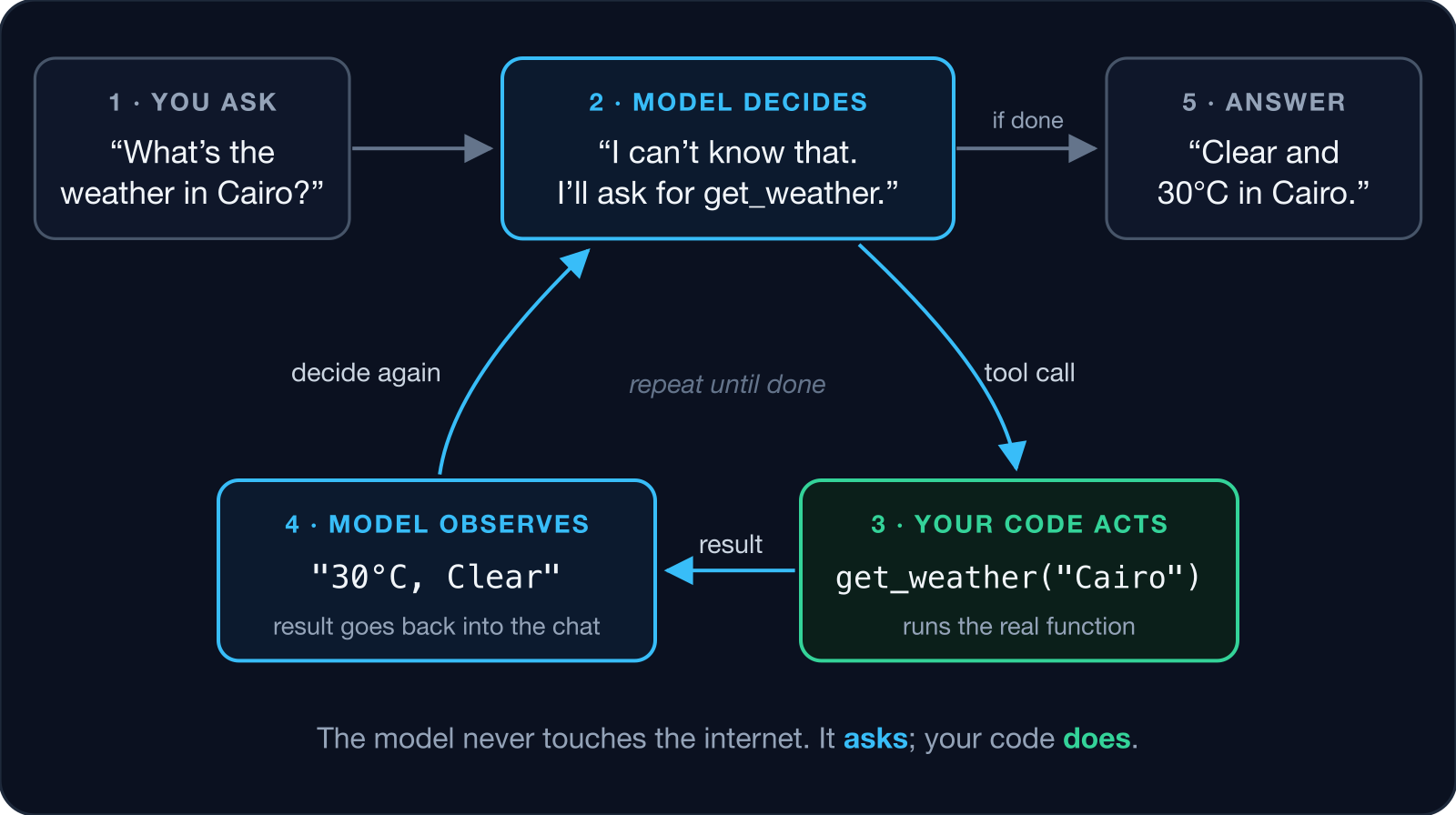
The model never touched the internet. It asked, your code did, and the answer went back into the conversation. Decide → act → observe → decide again. That little circle is the heart of every agent you've ever heard of — coding assistants, research bots, customer-support agents. Same circle.
Chatbot vs agent, side by side
| A chatbot… | An agent… |
|---|---|
| only talks | uses tools to act |
| forgets you when the tab closes | remembers you across sessions |
| gives one answer and stops | loops until the job is done |
| has no idea when to give up | knows when to stop |
Every line in the right column is something you will build, in plain Python, in this series.
Why build it yourself?
There are frameworks that hand you an agent in three lines. They're great — after you understand what they hide. Until then, they feel like magic, and magic is impossible to debug.
Here's the surprising part: the core of an agent is tiny. The loop that makes it work is about fifteen lines of code. Once you've written those fifteen lines yourself, every framework, every "agentic" product, every conference talk suddenly makes sense. You'll look at them and think: oh — it's the loop.
If you can't build it from scratch, you don't understand it.
What's next
In the next article we take the very first step: talking to a model from Python in about five lines — and discovering something strange: the model forgets everything between two messages.
Try this before then: ask your favourite AI chat what time it is right now, then check your clock. Notice how it answers. That's the gap we're about to close.
Comments
Loading comments…